On 14 July 2026, on JPMorgan's second-quarter earnings call, CEO Jamie Dimon said the bank had close to 1,000 AI use cases in development. He said about 50 of them mattered most. For context, JPMorgan spends roughly USD 20 billion a year on technology. 50 out of 1,000 is 5%. So where’s the gap?
Banks spend more on AI than any other industry. Estimates for financial services in 2026 run up to USD 68 billion. On adoption, financial services sits second to technology at around 79%. HSBC reports more than 600 use cases in operation. DBS runs over 2,000 models across more than 430 use cases. Bank of America's assistant has handled 3.6 billion customer interactions.
The results trail the spend.
In McKinsey's 2026 State of AI survey, 36% of financial institutions attribute any impact on earnings to AI. Across all industries the figure is 37%. Only 6% of respondents in any sector get 5% or more of EBIT (Earnings Before Interest and Taxes) from AI. The Cambridge Centre for Alternative Finance surveyed 628 financial institutions in 151 jurisdictions this year, with the BIS, IMF, World Bank and World Economic Forum. 4 in 5 deploy AI. 14% say it changed their competitive position.
Dimon gave his own explanation at a data conference the year before. He said the hardest part is the data. In a bank, that data lives in the system of record, or in 5 of them.
What banks have actually put into production
One independent tracker reads the public disclosures of 140 banks and ranks their production AI use cases. The 3 most common are:
- AI governance arrangements (105 banks)
- Model risk management of AI (105)
- Oversight of third-party AI (100)
Model risk management means the controls a bank uses to validate and monitor its models. Fraud detection comes next at 90 banks. Customer-facing chatbots follow at 76. Credit underwriting sits at 57.
So in that sample, the most common production AI use case is governing AI. Fraud detection, chatbots and underwriting all rank below the 3 control functions.
There's a practical reason for that order.
- A chatbot needs the account balance and a few recent transactions.
- A fraud screen needs the transaction in front of it.
- A document reader needs the document.
A team can build each of those against one system and ship it. The rest of the bank's data can stay out of scope.
Why the models stay at the customer service channel
A pricing decision needs the customer's deposits, their lending history, their card behaviour and the bank's own funding cost. It needs all 4 at once and all current. A limit increase needs the same. A product offer, a regulatory return and an intraday liquidity position each need the same customer data from several systems at the same moment.
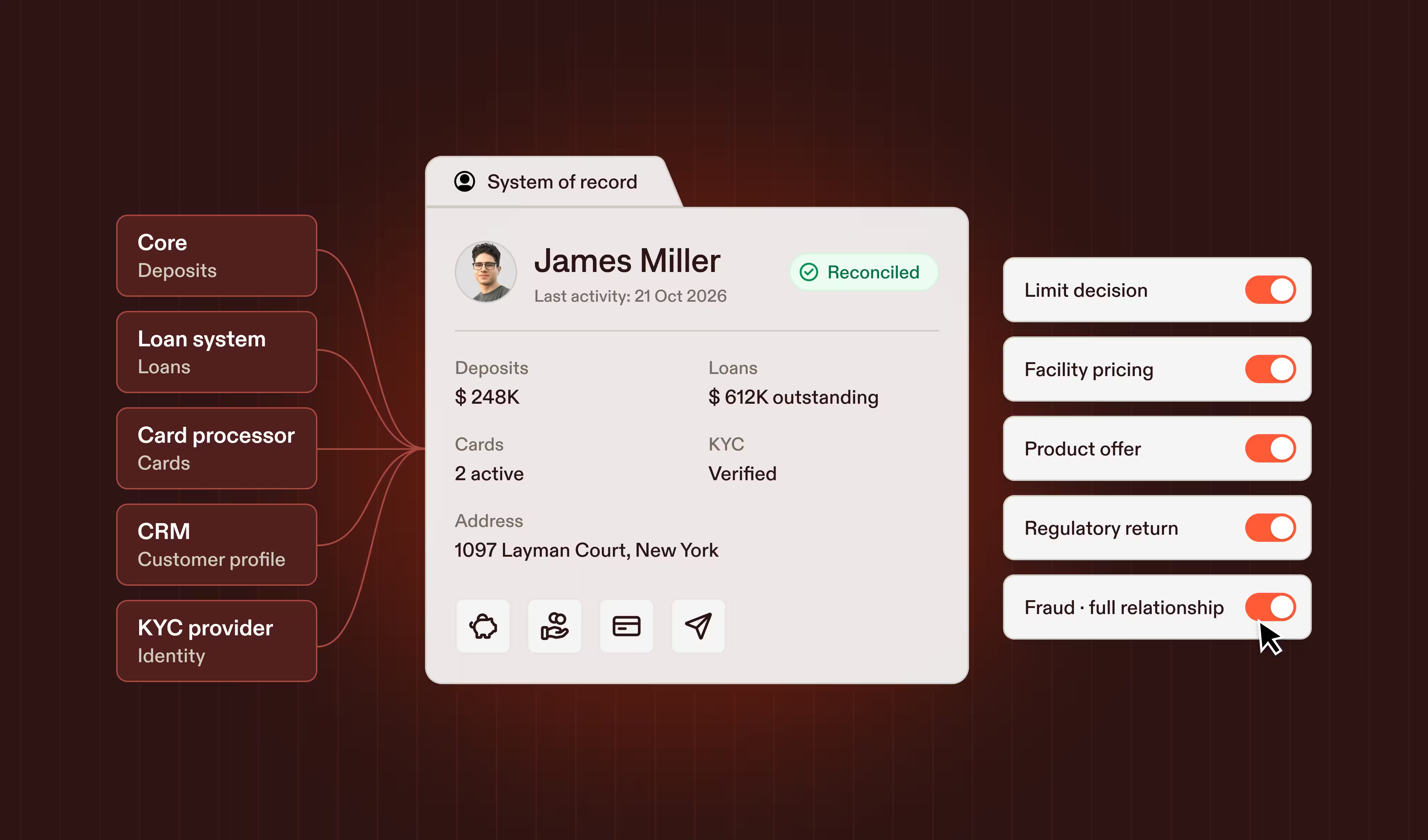
In a typical bank, those systems hold different versions of the customer.
- The core holds the deposits.
- A loan management system holds the loans.
- A processor holds the cards.
- A CRM holds the customer profile.
- A KYC provider holds the identity.
The bank bought each one in a different decade from a different supplier. JPMorgan's own CEO wrote in 2023 that modernising the bank's estate meant replatforming or rewriting approximately 4,000 applications. 5 of those systems store the customer's address, and the 5 copies differ.
A model that reads from all 5 gets 5 answers. So the team points the model at the one system with clean data, which is usually the customer service channel. Pricing, limits and credit decisions keep running on spreadsheets and committees.
Fragmentation sets the list of use cases a bank can build.
It keeps the model at the service channel and away from the decisions that move the income statement.
McKinsey's own read of its high performers points the same way. The organisations earning money from AI share coherent data and processes across the business.
What changes on one ledger
Put deposits, lending, cards and payments on one real-time double-entry ledger, so the bank has one system of record for the customer. A bank can then put AI on 3 kinds of work, in this order.
- Decisioning comes first. A credit officer can set a limit, price a facility or choose an offer against the whole customer, because one record holds the whole customer with one balance and one audit trail. The fraud model gets the full relationship as its input.
- Reporting comes second. A finance team builds a regulatory return, a liquidity position or a board pack from one ledger. Nobody reconciles 2 sources first, because there's one source.
- Analysis comes third. Analysts can ask questions that span deposits, loans and cards without requesting an extract from each system. The hundreds of use cases below Dimon's top 50 then have a single record to run on.
A bank doesn't have to replace everything at once to get there. Each new product has to post to the same ledger and write to the same customer record.
Count the use cases that cross a system
Ask your AI team one question. Of the use cases in production, how many read from or write to more than one system of record? Governance arrangements don't count. A chatbot that only reads a balance doesn't count.
The number is usually small. It shows how far a model can reach across the systems you run today. To raise it, a bank has to give its products one system of record before it buys another model.