On 5 October, Khaled Mohamed Balama, governor of the Central Bank of the UAE (CBUAE), convened the chief executives of the country's banks and read out the running total. Through the end of August, the Financial Institutions Resilience Package (FIRP) had delivered AED15.9bn (USD4.33bn) in payment deferrals and fee waivers to 155,971 customers. The breakdown is where it gets interesting. 849 private sector companies took AED10.7bn. 6,441 SMEs took AED2.9bn. And 148,681 individual borrowers took AED2.3bn (USD626m), an average of about AED15,500 each. Retail borrowers were 95 per cent of the beneficiaries and 14 per cent of the money. Those 148,681 schedules each had to be changed individually, and the small average balance attached to them did nothing to reduce the number of changes. That work lands on whatever loan management software the bank is running.
Why a regulator reaches for a deferral
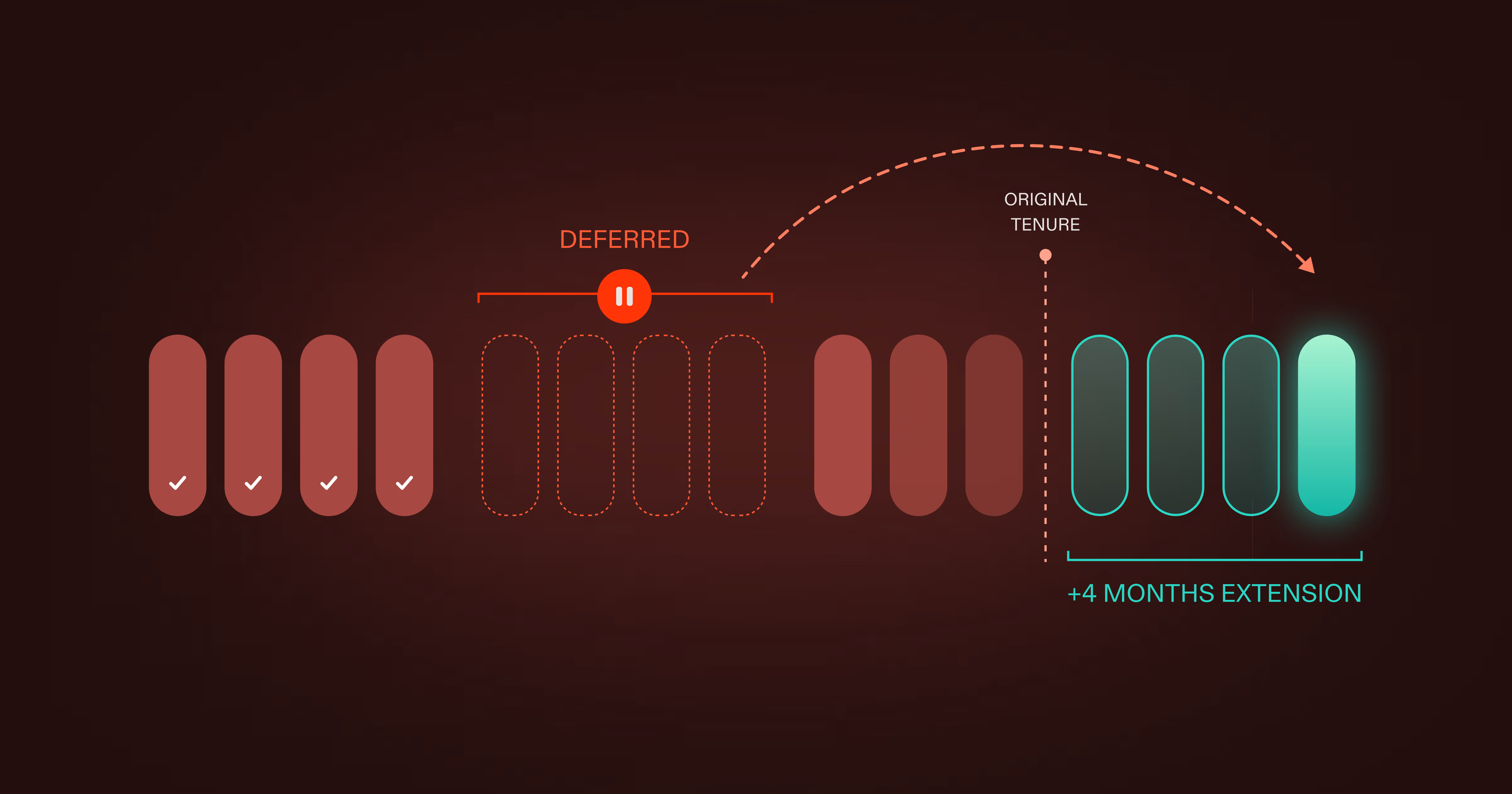
A deferral moves scheduled instalments to a later point in the life of the loan without recording them as missed. The borrower stops paying for an agreed window, the term extends by roughly that window, and the account keeps its performing status with both the lender and the credit bureau.
The instrument exists because an income shock and a credit deterioration look identical inside a repayment file. A borrower whose salary stopped for ten weeks and a borrower whose business has structurally failed both miss the same instalment on the same date, and the servicing system cannot tell them apart. Left alone, it treats both the same way: a late fee, a days-past-due counter that starts incrementing, an account routed into collections, a mark submitted to the bureau, and after 90 days a Stage 3 classification, the impaired bucket under IFRS 9, the accounting standard that sorts every loan into one of three risk stages. That produces a provision on the bank's balance sheet and a record on the borrower's credit file that outlasts the shock by years. A deferral suspends that sequence on the assumption that the income returns.
The UAE reached for it in March, after a period of regional geopolitical unease disrupted travel, transport and the businesses sitting downstream of them. The support figures show where the pressure landed. By 1 May, transport led with 361 companies supported, followed by tourism at more than 170 and entertainment at 134, with hospitality and aviation close behind. Those are payroll-heavy industries, and the people on those payrolls hold car loans and personal loans with instalments due on fixed dates. Their income paused for weeks while the instalment dates stayed where they were.
So the CBUAE approved FIRP on 18 March: six months of deferral without triggering a default classification, suspension of interest and fees on some facilities, no minimum loan size, temporary permission for banks to draw down the capital and liquidity buffers regulators normally require them to hold untouched, and more than AED1 trillion in foreign exchange reserves standing behind it.
849 corporate deferrals can be processed by a credit committee. Each file gets a memo, a signature and a rebuilt schedule, and if it takes a week per name, the team gets through them. 148,681 retail deferrals cannot be processed that way. Somewhere in a UAE bank there is a car loan with an instalment due on the 5th of every month, and for six months that instalment had to stop being due without being recorded as missed. Every system that believed it was due had to be told, and told the same thing.
What loan management software decided last time
Nothing in the published UAE data suggests the relief failed to land. The CBUAE's own totals say it reached 155,971 customers across three segments, and the banking indicators released alongside them are strong. What the international record offers is a measure of how much of an outcome like that is settled by servicing rather than by policy, and the clearest version comes from the last time a regulator ordered relief at this scale.
Four Federal Reserve economists, Kim, Lee, Scharlemann and Vickery, matched 10.3 million American home loans against credit bureau records and servicer financials, in work later published in the Journal of Financial Economics. Every loan in the sample was government-backed, insured by the Federal Housing Administration or the Department of Veterans Affairs and pooled into securities guaranteed by Ginnie Mae, the US government agency that stands behind them. That mattered, because the CARES Act, the 2020 US pandemic relief law, gave every borrower on a government-backed mortgage the right to pause payments on request, forbearance being the American term for what the CBUAE calls a deferral. The question the authors asked was narrow: among delinquent borrowers who held that right, who didn't get it?
The answer depended on the servicer, the firm that runs the loan day to day, takes the payments and decides what happens when one is late. For observably similar loans, the probability that a delinquent borrower received no forbearance ranged from 10 per cent to 60 per cent across servicers. Weighted by loan count, a servicer at the 90th percentile left 38 per cent of eligible delinquent borrowers without forbearance against 12 per cent at the 10th percentile. Among borrowers 60 days or more past due, the worst-performing servicers missed forbearance at six times the rate of the best.
Borrowers at the two ends looked the same going in. Comparable credit scores, comparable debt-to-income, comparable non-mortgage balances, and delinquency transitions in the months before the pandemic that showed no systematic difference. The entitlement was identical and the paperwork was identical. The variable was the servicer, and the paper traces it to scale and capacity: larger servicers delivered forbearance at measurably higher rates, and the Consumer Financial Protection Bureau (CFPB), the US consumer finance regulator, logged the operational signature at the laggards, including failures to process forbearance requests on time and websites that didn't work.
What one deferred instalment touches
Return to the car loan. Granting the deferral means the amortisation schedule is rewritten and the term extends. Most systems manage that.
The work is in everything downstream that had its own opinion about the 5th of the month. The days-past-due counter has to hold at zero rather than tick. The collections queue has to not pick the account up. The dunning sequence, the automated run of reminder emails and calls that chases an overdue account, has to not fire. Interest accrual has to continue or pause according to the terms of the specific facility, since the CBUAE package suspended interest and fees on some facilities and not others. The statement generator has to describe the account accurately. The IFRS 9 staging engine has to leave the loan where it is, because the package allowed deferral without triggering a default classification. And the monthly submission to Al Etihad Credit Bureau, the UAE's credit bureau, which holds records on more than 13 million individuals and companies and scores them on their likelihood of missing a payment in the next 12 months, has to show the instalment as deferred rather than unpaid.
When the CFPB reviewed what borrowers were complaining about in 2021, after mortgage complaints hit more than 3,400 in a single month, most of the pattern sat after the grant: borrowers in authorised forbearance receiving statements that described their accounts as delinquent, and forbearance reported inaccurately to credit bureaus. Those are records that stopped agreeing with each other, in institutions where the decision to grant relief lived in one system and the systems that act on a missed payment lived somewhere else.
The UK had the same experience at a different scale. The Financial Conduct Authority, the UK's conduct regulator, reviewed 68 firms covering roughly half the market after around 4.5 million payment deferrals had been granted, and found the capacity had largely been built. What it flagged was the quality of what happened inside it, including poor record-keeping and a surge of inexperienced staff handling cases with low quality-assurance coverage. The capacity was added in people, under time pressure, with the quality controls lagging behind the headcount.
Fixed-price debt does not defer the same way
In the UAE the question has a second dimension that most of the published forbearance research never had to deal with. A large share of UAE retail credit is Islamic, and a murabaha is a sale at a disclosed mark-up, with the total price agreed at signing. The debt is fixed from that moment and does not grow with time. As Taqi Usmani, who chairs the Shariah board of AAOIFI, the body that writes the standards most Islamic banks follow, puts it, once the price is fixed it relates to the commodity and not to the time, so the price can never be increased by the seller.
A conventional six-month deferral works by pushing the schedule out and letting interest accrue across the extension. That mechanism is unavailable on a murabaha. Rescheduling a fixed-price debt for any increase is riba, the prohibited gain taken on a debt for the passage of time, so the deferral has to be effected through a different contractual route with a different accounting treatment, a different disclosure and a different entry in the ledger. A dual-book lender running Islamic and conventional lending needs both paths to exist in the same servicing system and produce the same customer outcome. Where a servicing platform handles one natively and the other by exception, the gap tends to get closed with a parallel process and a manual reconciliation that outlives the deferral.
The unwind is the part still running
The earliest FIRP cohort, granted in March, reached the end of its six months in September. As of 30 July the deferred book stood at AED13.5bn across more than 135,000 customers, having more than doubled since May, and that book is now rolling back into normal servicing.
Rolling it back asks more of the system than granting it did. Every loan has to be re-staged individually under IFRS 9 as Stage 1, 2 or 3, and unlike 2020, when the CBUAE issued joint guidance on applying IFRS 9 through the pandemic alongside the regulators of the Abu Dhabi Global Market and the Dubai International Financial Centre, no equivalent joint guidance has been issued this time. Alvarez & Marsal, the restructuring advisory firm, reads the package as leaving each bank to make its own judgement on whether arrears or revenue declines in this period constitute a significant increase in credit risk, with the rationale documented as it happens because guidance may follow. Bloomberg Intelligence analysts expect a six to twelve month lag before the reclassification shows up in balance sheets at all. Asset quality currently reads well: non-performing loans at 2.6 per cent of the book at the end of August, or 1.2 per cent once provisions are netted off, against bank lending growing 18.8 per cent year on year.
So the car loan comes back. The instalment becomes due again on the 5th, at a new amount, on a term that now ends six months later than the contract said, with a staging decision attached that a regulator may ask about in two years and that has to be defensible from the record rather than from memory. At 148,681 accounts, that stops being a credit operations task and becomes a question about the system, and the answer to it is largely set by architecture chosen long before any circular arrives.
Two things worth asking the lending team this quarter. How many systems in the bank can independently mark a customer delinquent, and are all of them downstream of the one place a deferral gets recorded? And if the central bank issued another instruction next month, how long from the circular landing to every affected schedule being repriced, with the bureau file, the collections queue and the staging engine already agreeing? Both are worth knowing before the next instruction lands rather than after it.