The 62nd minute of Cape Verde against Saudi Arabia in Houston, and someone in the stadium taps a phone to buy a drink. That tap is the easy part. In the same few seconds, tens of thousands of people across the venue reach for the same thing, and a much larger crowd watching from Riyadh to São Paulo hits merchandise sites, streaming platforms, and betting apps at once. The scoring of a single goal produces a synchronized spike, not a smooth curve, and synchronized spikes are what break systems built for average demand.
The 2026 World Cup runs 104 matches across the United States, Canada, and Mexico, and FIFA projects a revenue cycle near USD 10.9 billion to protect through the tournament. Visa is the official payment provider, handling ticketing, in-stadium purchases, and the fan zones outside. The front-end story is the one everyone tells: no cash, no queue, a tap so quick the fan doesn't notice it happening. That story is true, and it's also the least interesting thing about what's going on.
Transaction processing is the part nobody sees
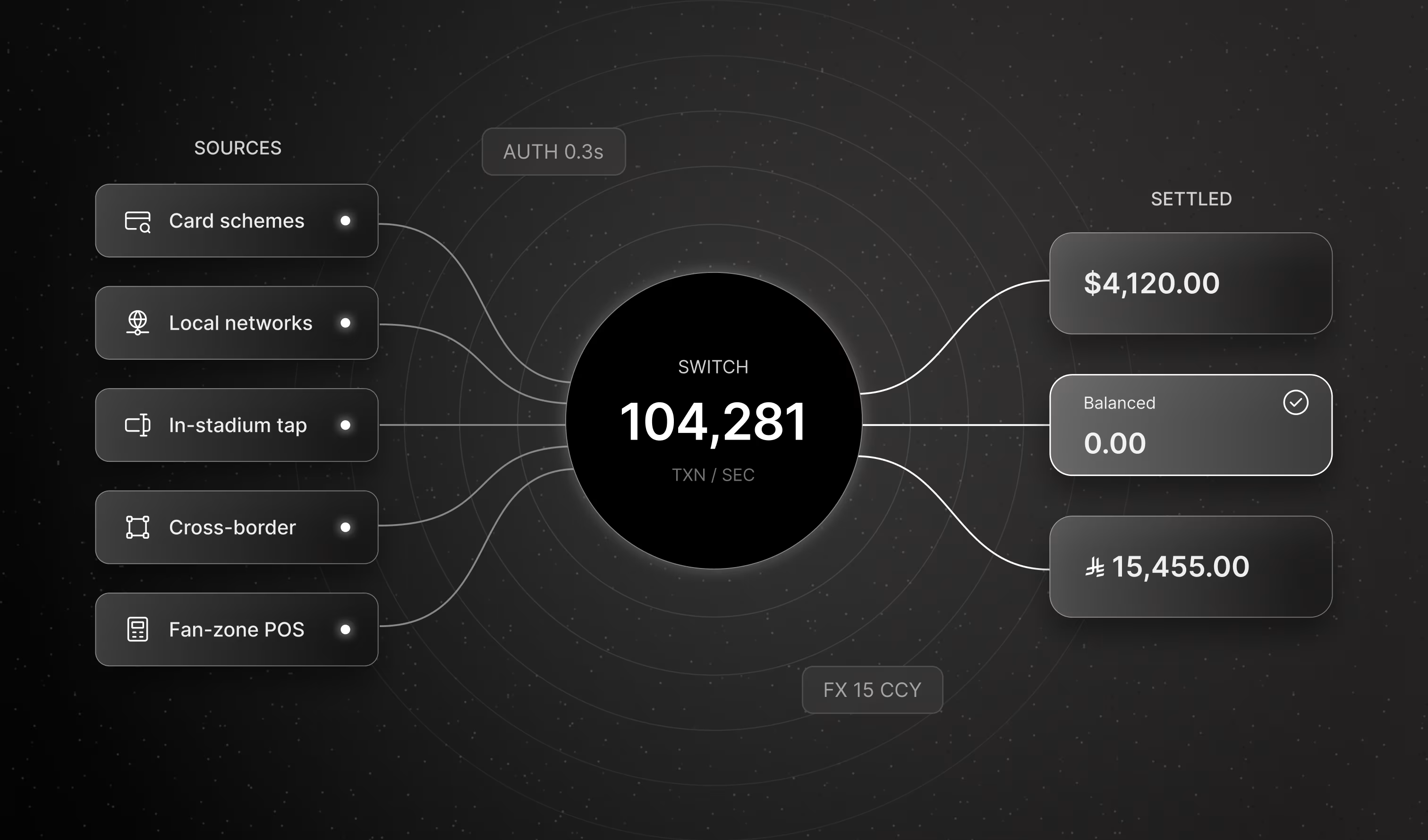
Behind one contactless tap sits a chain of steps that has to complete in well under a second. The card scheme has to be reached, the issuing bank has to authorise, the currency has to be handled, and the transaction has to be recorded somewhere it can later be reconciled. Multiply that by a stadium, then by 104 stadiums' worth of matches, then by every cross-border purchase from a fan whose card was issued in one country and used in another. The tap is one event. The transaction processing behind it is many, and each link in that chain is a place where things can fail under load.
Peak load is the whole problem. A payment system that runs comfortably on a Tuesday afternoon can fold when a knockout-stage shootout sends everyone to the same checkout in the same ten seconds. The institutions that hold up are the ones that designed for the spike from the start, with a transaction engine built to absorb high transaction volumes at low latency rather than one that scales by bolting on servers and hoping.
Fragmentation is the cost that shows up later
Here's where the tournament exposes something most of the year hides. Payment providers working the World Cup are quoting support for more than 150 processing currencies and 15-plus settlement currencies. A fan in Lagos, a merchant in Dallas, and a bank in Doha are all touching the same transaction, in different currencies, under different rules. If an institution has stitched that capability together from separate systems, one for card schemes, one for local networks, one for FX, one for reporting, then every one of those seams is a reconciliation problem waiting for the tournament to surface it.
The customer never sees the seams. The fan taps, the drink is paid for, and the experience is clean. The institution carrying it inherits the mess: transactions that cleared in four different systems and now have to be matched, reported, and reconciled after the final whistle. Fragmentation doesn't announce itself at the point of sale. It arrives weeks later as a month-end that won't close.
What holds up under load
Paysafe's research on the tournament found that 44% of consumers have abandoned a purchase because their preferred method wasn't available, and the overwhelming majority would switch providers after one bad payment experience. At World Cup volume, that isn't a rounding error. Every declined transaction under load is a fan who walked away and a merchant who lost the sale, and it happened because the stack underneath couldn't take the surge.
A unified transaction engine changes the maths. Consolidating processing across card schemes, national networks, and payment types into one system, with real-time transaction monitoring and direct scheme connections built in, means the institution isn't reconciling four systems against each other while the volume is still climbing. What's needed here is a transaction processing module built for exactly this shape of problem: a single switch that handles diverse payment types and high transaction volumes without the operational drag of holding several systems together by hand.
The World Cup is a compressed version of what every financial institution faces year-round, just louder. The fan taps once. Whether that tap clears cleanly, settles in the right currency, and reconciles without a fight depends entirely on the engine nobody in the stadium will ever think about.